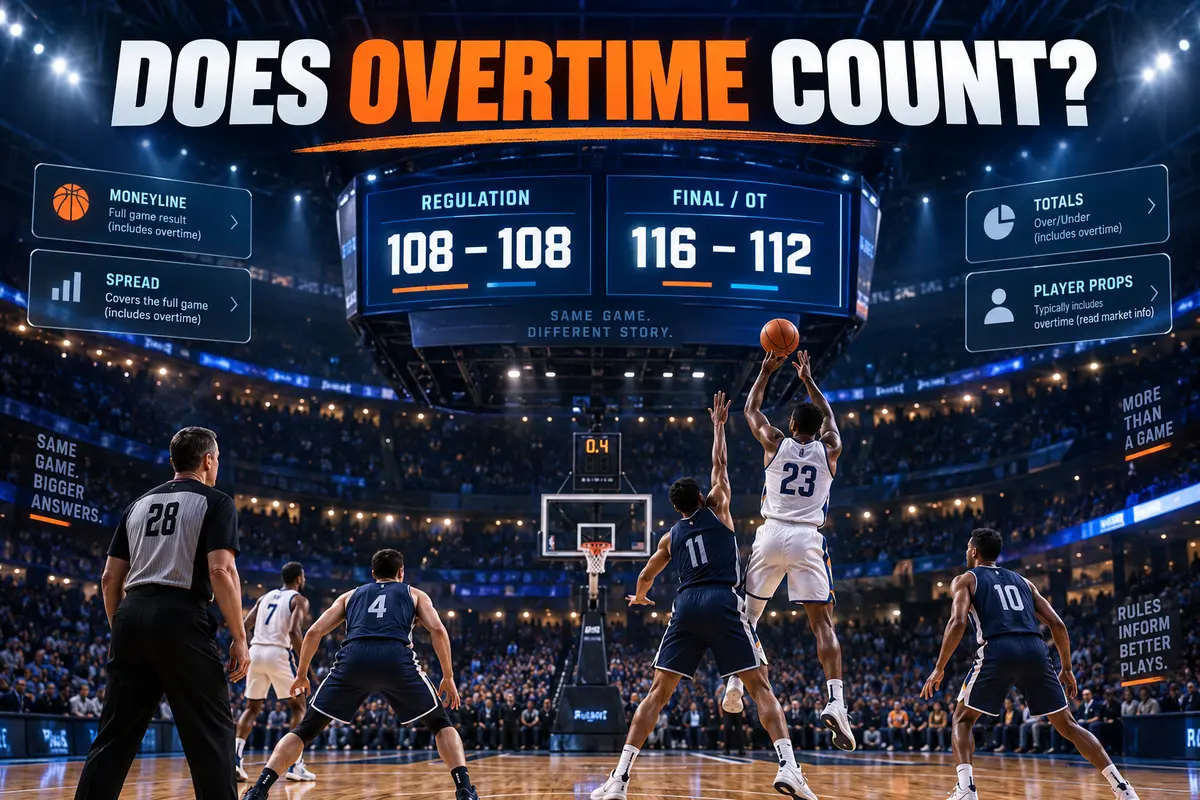
NBA overtime can turn a tied regulation score into a moneyline result, push a favorite across the spread, send a total over its line or add to a player’s final statistics. That is why readers using our NBA odds betting guide should verify the settlement basis before comparing prices. Two offers that look similar can represent different products if one says “including overtime” and another says “regulation time.”
Full-game markets versus regulation-only markets
A standard NBA game has four regulation quarters. If the score is tied, the league plays one or more overtime periods until there is a winner. Sportsbooks commonly build their main two-way full-game markets around the official final score, including overtime. This structure makes sense for a two-way moneyline because an NBA game cannot finish tied after overtime.
A regulation-only market stops after the fourth quarter. It may be presented as a three-way result—home, draw or away—or as a specially labeled regulation spread or total. The wording matters more than the location of the bet on the screen. “Game,” “full game,” “including OT,” “regulation,” “four quarters” and “60-minute” style labels are settlement instructions, not decorative text.
Operator rules can also define how abandoned, shortened or postponed games are handled. Those cases are separate from ordinary overtime and should not be inferred from the normal full-game rule.
Does overtime count by NBA market?
Typical treatment only; always verify the exact market and operator rule.
| Market | Typical treatment | Important exception |
|---|---|---|
| Full-game moneyline | Overtime commonly included | Regulation-only or three-way result |
| Full-game point spread | Overtime commonly included | Regulation-only spread |
| Full-game total | Overtime commonly included | Regulation-only total |
| Full-game player prop | Often includes overtime statistics | Operator or prop-specific exclusion |
| First half or quarter | Later overtime excluded | Only the named period is counted |
| Second half | Depends on posted definition | Some rules include OT; others specify regulation half only |
How overtime affects an NBA moneyline
For a standard two-way full-game market, the team that wins after overtime is normally the moneyline winner. A 108–108 score after four quarters is not the settlement result because there is no winner yet. If the home team wins 116–112 after overtime, the home full-game moneyline wins and the away moneyline loses.
A regulation-only result is different. At 108–108 after four quarters, the regulation result is a draw even if one team wins later. This is why the market must be identified before interpreting NBA moneyline odds. A two-way full-game price and a three-way regulation price cannot be compared as though they settle on the same event.
How overtime affects NBA point spreads
Standard full-game NBA point spreads commonly use the score after overtime. Suppose the home team closes at −3.5. Regulation ends 108–108, then the home team wins 116–112. The final margin is four points, so the home team covers −3.5. The away team at +3.5 does not cover.
If the line were home −4, a 116–112 final creates an exact four-point margin. Under ordinary whole-number spread settlement, that would be a push and the stake would normally be returned. A regulation-only −3.5 market would instead be evaluated against 108–108, so the home side would not cover. The same basketball game can therefore create different outcomes because the markets define different scoring windows.
How overtime affects NBA totals
A full-game over/under usually adds every point scored in overtime. In the example, regulation produces 216 total points. The 116–112 final produces 228. A full-game total of 220.5 would be under at the end of regulation but over after overtime. A regulation-only total of 220.5 would remain under because it stops at 216.
This difference is especially important when comparing NBA over/under totals. Confirm that the line, settlement window and game are identical. A lower regulation-only total is not automatically a better price than a higher full-game total; it may simply exclude possible overtime scoring.
Player props and overtime statistics
Many full-game NBA player prop markets use the player’s official final statistics, which normally include overtime. A player with 22 points after regulation who scores five in overtime finishes with 27. For a standard full-game points prop at 24.5, those extra five points can change the result.
Do not apply that assumption to every prop. Some specials specify a period, a milestone timing condition or another settlement method. First-quarter props stop after the first quarter. First-half props stop at halftime. A prop such as “to score in every quarter” is governed by its own wording and does not necessarily gain a fifth required period when overtime occurs. Voided bets, minimum-participation requirements and player-status rules also vary by operator.
Quarter, first-half and second-half exceptions
Quarter bets settle on the named quarter, so overtime is not a fifth quarter for fourth-quarter settlement. First-half markets likewise use the first two quarters only. The more difficult case is a second-half market. Some operators define “second half” as the third and fourth quarters plus overtime, while others label a regulation-only window or provide market-specific treatment.
Never infer the second-half rule from the full-game rule. Open the operator’s basketball section and look for an explicit definition. If the market screen and general rules conflict or remain unclear, save the bet description and ask support before placing the bet.
Worked settlement example
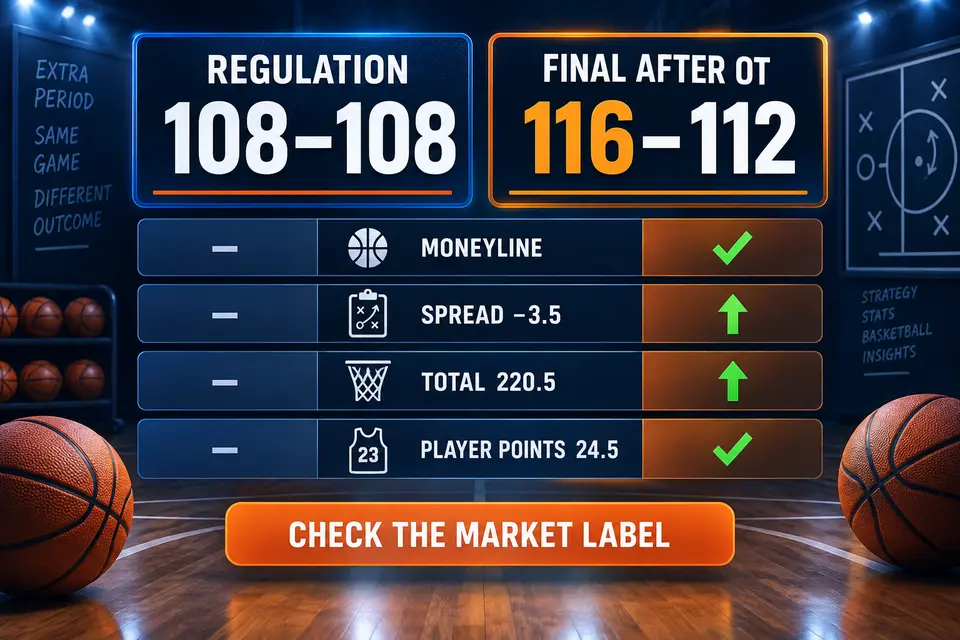
Assume regulation ends Home 108, Away 108. Overtime ends with a final score of Home 116, Away 112. The home team wins the game by four and the combined final total is 228.
- Home full-game moneyline: wins because the home team won after overtime.
- Home full-game −3.5: wins because the final margin is four.
- Full-game over 220.5: wins because 228 points were scored.
- Regulation home moneyline in a three-way market: loses if the selected outcome was “home,” because regulation ended in a draw.
- Regulation under 220.5: wins because the four-quarter total was 216.
- Player over 24.5 points: wins only if the applicable full-game prop includes overtime and the player’s official final total exceeds 24.5.
Sportsbook rules reviewed for this guide
Settlement policies can change, and availability varies by jurisdiction. We reviewed public basketball or house-rule materials on September 21, 2026 from DraftKings basketball rules, FanDuel Sportsbook house rules and bet365 basketball rules. These links are examples of operator-specific documentation, not a universal rulebook or an endorsement.
Before relying on any summary, confirm the rule page currently shown to your account and jurisdiction. A sportsbook may revise wording, introduce a special market or apply different rules to a league, live market or promotional product.
Four-step settlement checklist
- Read the complete market label. Look for “full game,” “including overtime,” “regulation only,” the named quarter or half, and any three-way result.
- Identify the scoring window. Decide whether settlement stops after four quarters or uses the official final score.
- Check the official result and statistics. Separate the regulation score from the final score after overtime and use the operator’s recognized data source.
- Read the operator’s current rules. Check basketball rules plus any prop, live-betting, abandonment or minimum-participation section.
A screenshot of the market name, line and timestamp can help if a settlement question arises. It documents what was displayed without replacing the operator’s rules.
Frequently asked questions
Does overtime count in NBA moneyline bets?
It commonly counts for a standard two-way full-game moneyline. A regulation-only or three-way moneyline can stop after the fourth quarter, so always check the label.
Does overtime count toward NBA point spreads?
It commonly counts for a standard full-game spread. It does not change a first-half or quarter spread, and a regulation-only full-game spread uses the score after four quarters.
Does overtime count for NBA over/under totals?
Standard full-game totals commonly include overtime scoring. Regulation-only and period totals use their named scoring window.
Does overtime count for NBA player props?
Many full-game props use official final statistics including overtime, but prop-specific and operator-specific rules can differ. Period props do not include statistics scored outside the named period.
Is overtime included in second-half bets?
It depends on the sportsbook’s definition. This is one of the markets where checking the published basketball rules is especially important.
Editorial note: This guide describes common settlement structures for educational purposes. It does not guarantee how a particular bet will be settled. Operator rules and the exact market wording control. Reviewed September 21, 2026.