
Use this explanation with the NBA odds comparison table. The examples below are educational, use decimal notation and separate market data from editorial interpretation.
Opening and closing line comparison
The role, strength and limitation of each market snapshot.
| Snapshot | What it shows | Main limitation |
|---|---|---|
| Opening line | Early market estimate | Information may still be incomplete |
| Current line | Latest available observation | Can continue moving |
| Closing line | Final pregame observation | Definition varies by source |
| Final score | Game outcome | Does not prove the earlier price was efficient |
Treat every line as a timestamped observation
Opening, current and closing numbers are not permanent properties of a game. Each records what a source displayed at a specific moment. A complete history needs the exact line, decimal price, source and time.
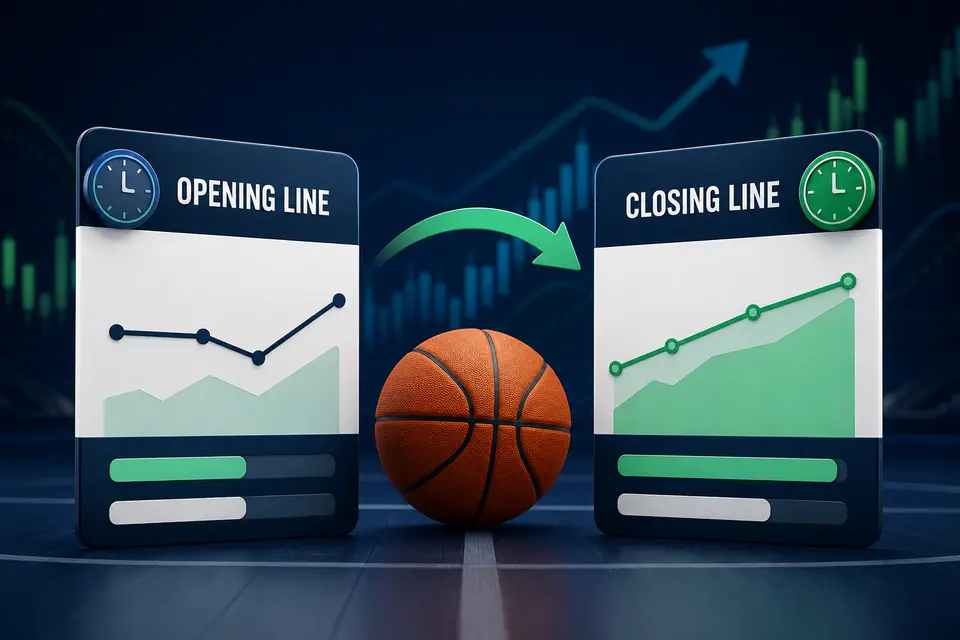
Movement can have several causes
Confirmed lineup information, rest context and market activity can all contribute to movement. Without evidence, the chart cannot identify a single cause. Explain plausible inputs separately from verified events.
Closing-line value is a process measure
Comparing an earlier price with the closing market can help evaluate whether a research process consistently found stronger numbers. It does not guarantee profit in a single game, and the result should be evaluated across a meaningful sample.
- Define the source's closing time
- Match the exact market and line
- Keep result analysis separate
- Use a sample rather than one outcome
Common questions
Is the closing line always the most accurate?
It often contains more pregame information than the opener, but it remains a market estimate and can still be wrong about the final result.
Can opening and closing prices be compared if the spread changed?
They can be used to document movement, but they are not identical selections. Record both the handicap and price at each timestamp.
Method: educational analysis reviewed against our data methodology and editorial policy. Illustrative prices are not current markets or recommendations.