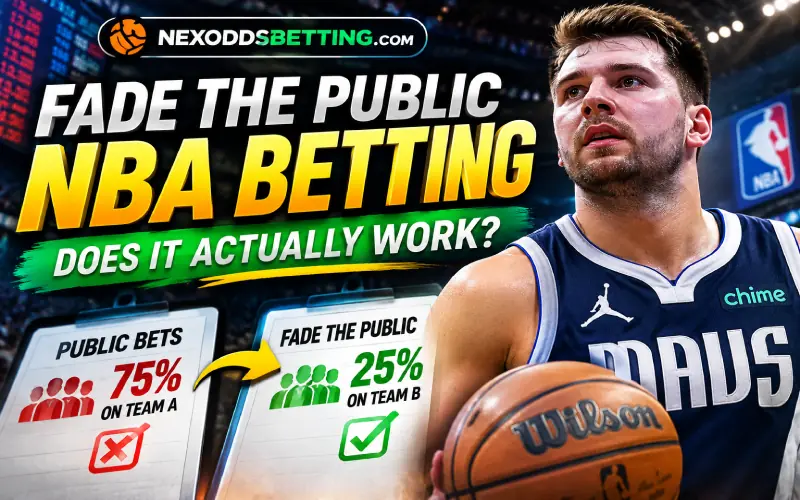
Ever seen the Lakers attract 80% of betting tickets, only for the spread to move in favour of their opponent? That's exactly the kind of market movement that makes Fade the Public NBA betting worth examining. The strategy involves going against the majority when betting trends and odds movement suggest the public might be backing an overpriced team. But does it actually work, or is it just another popular betting theory? Let's break down the numbers and find out when fading the crowd makes sense.
What Does It Mean to Fade the Public NBA?
By looking at NBA public betting percentages, you can see which team attracts the most betting attention and whether the crowd is heavily backing one side. For example, if most bettors support the Golden State Warriors against an opponent, a contrarian bettor might consider taking the other team instead.
The logic is straightforward: popular teams attract casual money, sometimes pushing betting lines beyond what their actual performance justifies. Teams like the Lakers, Warriors, and Celtics regularly attract attention from Filipino fans, particularly during high-profile matchups.
However, popularity doesn't automatically make a team a bad bet. A strong favourite can still cover the spread, even when most tickets support it. The idea behind contrarian NBA betting is to identify situations where the market price might be influenced by public sentiment rather than the underlying matchup.
For NBA games tipping off during Manila morning hours, bettors often check a betting-splits page before placing a wager. That's where ticket and money percentages become useful.
NBA Handle vs Tickets: Why the Gap Matters
Two numbers deserve your attention: ticket percentage and handle percentage.
NBA ticket percentage represents the proportion of individual wagers placed on a particular side. If a team receives 75% of tickets, three out of every four recorded bets support that team.
Handle percentage measures the proportion of total money wagered on that side. A bettor staking ₱500 and another staking ₱10,000 each count as one ticket, but their contributions to the handle are very different.
This is why NBA handle vs tickets comparisons can reveal more than looking at public support alone.
Illustrative example only: The following figures are hypothetical, not actual sportsbook data or historical NBA results.
| Betting metric | Lakers | Opponent |
|---|---|---|
| Ticket percentage | 78% | 22% |
| Handle percentage | 55% | 45% |
| Difference (handle minus tickets) | −23 pts | +23 pts |
The opponent receives fewer tickets but a larger share of money relative to its ticket share. That could indicate larger wagers on the less popular side.
The takeaway: a significant gap between tickets and handle deserves investigation, but it doesn't prove professional bettors are backing that team.

When Fading the Public Makes Sense (And When It Doesn't)
So, when should you actually consider fading the crowd? There are a few situations worth watching:
- Heavy one-sided ticket counts: A popular team receiving 75% or more of tickets deserves closer examination, especially if its odds appear inflated.
- Primetime matchups: Nationally televised games can attract casual money, particularly when star players and popular franchises are involved.
- Handle-versus-ticket splits: A team receiving fewer tickets but a higher handle percentage has a larger average wager in that sample. That does not establish who placed the bets.
- Reverse line movement: This happens when the betting line moves towards the side receiving fewer tickets. For example, a team might move from +5.5 to +4.5 despite attracting only 30% of tickets. It can suggest influential money on that side.
Still, reverse line movement isn't automatic proof of sharp action. Sportsbooks adjust prices for several reasons.
When does fading fail? Small samples can produce misleading percentages. Injury announcements, rest days, back-to-backs, and changes to starting lineups can move NBA odds for perfectly legitimate reasons.
A line moving against the public isn't necessarily an opportunity. Sometimes the market simply has better information.
A Practical NBA Odds Betting Approach
If you follow NBA odds betting markets, treat public splits as supporting information rather than a standalone betting system. Here's a sensible process:
- Check the opening spread and current spread. Identify meaningful movement.
- Compare tickets and handle. Look for a meaningful difference rather than focusing on one percentage.
- Check the latest injury report, player availability and rest situation.
- Compare odds across available sportsbooks to understand whether the current price offers value.
- Decide whether the opposing side is genuinely undervalued. If the reasoning isn't there, skip the game.
The NBA is a high-volume betting market. Blindly fading every popular team won't guarantee positive returns. Public betting percentages also represent only the data collected by a particular provider or group of sportsbooks.
For example, if your planned bankroll is ₱1,000, decide your spending limit beforehand. Don't increase your stake simply because a betting split looks unusually one-sided.
Conclusion
Does the fade the public NBA strategy actually work? It can help in specific spots, but it is not a guaranteed edge. The strongest approach combines ticket percentages, handle differences, line movement, and verified injury information. Don't bet against the crowd simply because it's the crowd. Set a budget, never chase losses, and remember that NBA betting should remain entertainment, not a source of income. Check PAGCOR's responsible-gaming resources if you need support.
For a related explanation, read NBA sharp money and the limits of market signals.
Frequently asked questions
Does fading the public work in NBA betting?
It can help identify potential opportunities when public sentiment and market movement disagree. However, no evidence presented in this guide establishes that blindly betting against popular teams produces consistent long-term profits.
What is a good NBA ticket percentage to fade?
There's no magic percentage. A side attracting 70% or 80% of tickets might deserve further investigation, but you should also examine handle share, odds movement, injuries, and matchup conditions.
What is the difference between tickets and handle?
Tickets count individual wagers, while handle measures the total amount of money wagered. A team can attract most tickets without receiving most of the money.
What does reverse line movement mean?
Reverse line movement occurs when the odds move towards a team receiving fewer tickets. It can indicate influential wagers on that side, although other market factors can explain the movement.
Should Filipino bettors use public betting percentages?
Yes, as one research tool. Check reliable odds information, confirm player availability, and use only PAGCOR-licensed operators. Participation is restricted to eligible adults aged 21 and above; other prohibited-person rules also apply.